YEAR XII NO. 71
proscenio170@gmail.com
Eduardo Roda'
Bilingual writings
En. It.
Pictorial Autography
Eduardo Roda' as a child at the school 1962 ã Roda'Archives
Colored crayons in a red tin box, received as a gift as a child, mark my days, coloring them with patient images .
Childhood passes between Pentedattilo and San Basilio, flashes of creativity assurging preciseness.

Pentedattilo RC Italy photo courtesy MariaTeresa Bagnato
Over the years the learning of artistic subjects are accentuated with the end of secondary school and the beginning of high school courses at the Artistic Liceo of Reggio Calabria, in the premises of the current archaeological museum, we are in 1968.
This was followed by the Albertina Academy of Fine Arts in Turin, until '77, in Via Accademia Albertina n.6

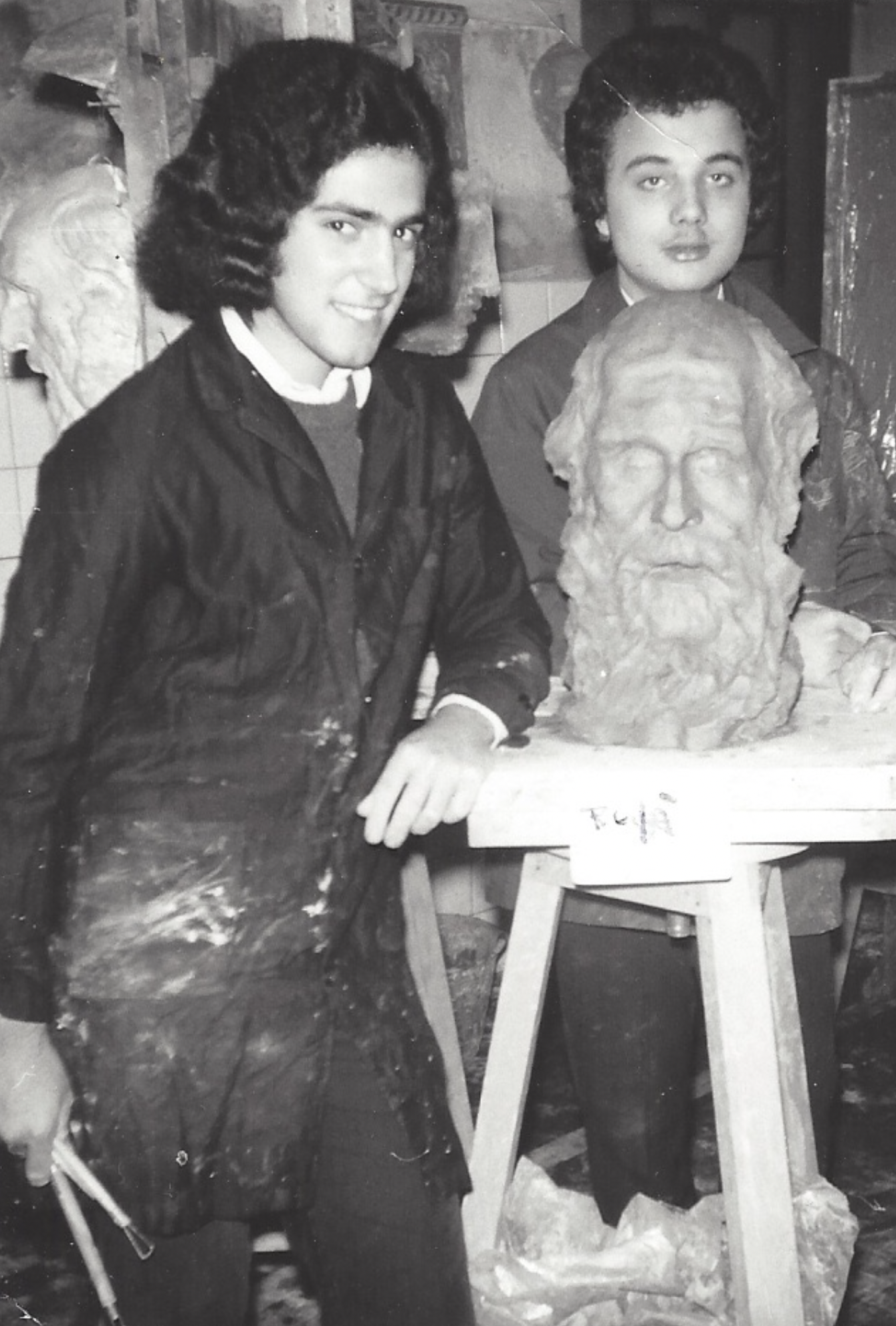
Eduardo Roda' student at the Liceo Artistico in Turin Italy 1971ãRoda' Archives
The atmosphere is effervescent-Turin's Arte Povera stands out in contrast to the American way of pop art, the work of Beppe Della Valle and Giulio Paolini.
Morning coffee at the corner cafe on Via Po, teachers and students, the paints from the night before.
Aosta, Volpiano and Turin


'72 was my first solo exhibition, at the Municipal Gallery of Aosta, under the arcades, near the Giacosa Theater, drawings and views of Roman Aosta in a metaphysical and surreal key, spaced a year apart from the first canvas, a copy from Morandi.
In '77 it is the turn of the municipal palace of Volpiano (Turin) to host in duo with friend/artist Ferruccio D'Angelo, the exhibition is structured around a series of tempera paintings on paper, where: line and stripe occupy the space that conceptually is inscribed in a white, square surface.
This is 1980 - " Opera 80 " D'Angelo - Fortino - Roda', birth of the Turin art group and first exhibition at the Centro Parete gallery in Turin, not far from Piazza Vittorio, along Po and Grande Madre on the opposite side.
Entering the gallery, a sequence of acrylics on canvas: Line strip and color, horizontal development is predominant.


Eduardo Roda' with the art critics Salvatore Spataro at the Galleria Centro Parete 1980 ©Rodà Archives
Formative years, those spent in Turin the baroque and art nouveaux, periodic visits to the Egyptian Museum more than Egyptian a real museum, Flemish art to the honor; daily visits to the modern art gallery GAM.
They are the 'important wealth of experience that I carried with me to the new world, to Canada', where I settled permanently since the early 1980s.
From Turin to Montreal and Quebec

Eduardo Roda' at the Christopher Columbus Community Center Montreal 1985 ©Rodà Archives
The theoretical researches around the theme of: line-strip-square and surface, begun in Italy were prolonged by being articulated in the works of the first half of the 80's in Montreal, the desire to re-propose those modernist entities' revised in a simulationist key, will find a wall in the exhibition In-Tension of 1985 at the Cristoforo Colombo Community Center in Montreal.
Constant visits to the Montreal Museum of Contemporary Art at first Du Havre Island and then Montreal, the documentation center and the Museum of Fine Arts, kept me abreast of the changes and interests of the moment.
I discovered with interest the emergence of new New York art movements, interesting exhibitions and debates.

"
LINE STRIP SQUARE SURFACE
......" In-tension " a line in vibration, a voice of color
multiple lines that add up become a stripe, which
in its maximal development will become a color field,
occupying the entire surface. Social pentagram
Of a horizontal development ........
"
The transition from the lozenge, outer surface, diamond to the vanishing point at the center, to multiple framings and viewpoints will be made rapidly, through an obligatory path from geometric drawing to painting, from 1986 onward.
Punctually the research will materialize through a series of drawings, traced in ink, homogeneous stroke and the same thickness, similar to the technical drawings for printer, the series Project Data Image "In Black and White " is born, and 'the new exhibition that resulted, of the spring of 1990 also at the Christopher Columbus Community Center in Montreal.;
"
MISE AU POINT - CADRAGE
....." Focusing the image" the drawing the first is
geometric, drawing a central perspective, the point
of escape is the center of the image, framed by
similarity as you frame when you take a photograph.
The mechanical process develops and becomes
integral part of the work from the moment when
for a practical need, an end in itself, photographing the work becomes a necessity'.......
"
The first in a series of 'installations that would characterize my 1990s would be the one held at the University of Quebec Gallery in Hull, '92, on the theme:
Cadrage Sequence With Blue Background.

Eduardo Roda' at the Université du Québec à Hull Qc.1992 C Rodà Archives
The works define the space that is intimate, a perfect double white cube, the three walls accommodate on one side the longest, the series of nine canvases, nine different framings, nine shades of blue, where the point of view shifts, at a time: right, center, left, follows: top right, center and left, to finish bottom right, center and left.
In the two smaller walls on the flanks, we find, first Monitor where the nine canvases are summarized, appearing in scattered order on a single surface, and opposite is A Framing of Overlapping Blues , where: the nine blues are layered overlapping one another, similar to the layering of memories of the past.
The empty fourth wall, lives on the echoes and reflections of the others.
The visual experience thus slowed down is experienced as a kind of slow art, invites us to pause on a still/image and gives the possibility of deciding times of fruition.
Second installation, we are in 1996 in Saint-Jean-Sur-Richelieu Qc. is the Action Art Contemporaine Gallery, which will be the exhibition space. "FACSIMILES" the theme that unites the works for the occasion.

Eduardo Roda' at the Galerie Action Art Contemporaine Saint-Jean- Sur-Richelieu QC. 1996 © Rodà Archives
The question of doubles is addressed, a series of four long works from the series
" closed-circuit" repeat the same framing, with variant colors from one to the other, while at the opposite end a group of three works unfolds in a dialogue of changing sizes: facsimile 2 , two works one the mirror of the other, monitors suspended like a monolith, with a flattened character that recalls the images of screens on the two sides and the third the largest, background a detail of an enlarged framing,
Where the real and the virtual are in the balance, the temptation is to break through and enter the screen into a new dimension.
Completing the installation is a series of drawings on paper printed in jet d' encre, attached directly to the wall, a coloristic variation of the same framing, entitled: Choice yours background.
1997, Laval salle Alfred Pellan and Matane Art Gallery.
The first, a group exhibition Trajectoir/Peinture was' curated by art critic Jean Dumont, the field from which his observation departed, were artists from Montreal and Laval, who having begun their creative activity in the early to mid 1980s and who at the time of the survey were in full possession of their means and medium.
His was a lightning studio visit, I recall with fondness our meeting, he stayed listening to the artist and took a few notes, after formulating a few questions, his choice was unambiguously firm and quick, limited to two works I had already exhibited facsimile2 and background.


Eduardo Roda' at the Matane Art Gallery Qc.1997 © Rodà Archives
Matane's installation at the Cegep gallery partly replicated the one at the Action Art Contemporaine Gallery. The four closed-circuit works, are featured together with a mosaic of nine canvases that echo their framing, forming a larger surface, complete the installation two large works on paper from the project data image series.
Galerie Bernard Montreal
In 1999, my collaboration with Gallery Bernard began, under the chairmanship of Michel Bernard and the direction of Gianguido Fucito, this collaboration would continue until 2012.

Eduardo Roda' at the Galerie Bernard Montréal Qc. 1999 © Rodà Archives
I had first met Fucito, in his gallery, Galleria Fucito when it was on Park Avenue early 1980s and then when he was director of Galleria Esperanza, around 1988, he had advised me to keep in touch. We met again on many other occasions and that of a parrinage for the Conseil de la Peinture. In 1996 his presence at my varnish at Galerie Action Art Contemporaine followed by a studio visit by him.
In 1997 he became director of Galerie Bernard, and after two years, he made me the proposition to join the ranks of artists represented by the gallery. There I met the Toupin, the Barbeau, the Gaevreau, Di Leo and Palumbo already well known and many other artists.
With Palumbo we had a solo show a duo in 1999, Jacques, the father of generative art in Quebec and Canada, had an impressive exhibition resume, his latest propositions were captivating, mine though rehearsed were measured in an open dialogue with an artist of another generation, an inegal growth experience.
Proscenium - As Near as Far
I have rarely had two parallel exhibition activities, was the case for the one with Palumbo at Galerie Bernard, simultaneously with the one at the Maison de la Culture in Ahuntsic/ Cartierville.
In the former I was sharing gallery space with another artist, so the choice of works was relative to that reality.
In the second the size of the space lent itself to full freedom of movement, so absolutely to a thematic installation.
The initial proposition that had been held, was enriched with new variations on my first visit to the premises: stepping through the double large inner entrance door, one is already in the exhibition space, a large hall, the front part hardly suitable for displaying paintings except for the wall to the right, the back part is the large container, somewhat like a stage with its imaginary proscenium delimiting the two zones.

Eduardo Roda' at the Maison de la culture Ahuntsic-Cartierville Montréal Qc. 2000 © Rodà Archives
Proscenium - as near as far
The 'initial idea, the exhibition project, which arose from the plans and dimensions, had to be enriched, the exhibition space was large and adding more works or intervening in situ, was the solution. The two options were considered, both in situ intervention and adding sculptures.
In the installation beyond the idea of the copy, there is that of the detail that is disproportionately enlarged to the point of being a prop.
The work as an "original" loses its "aura" of uniqueness as it is reproduced. The artist participates despite himself in the reproduction of his work when he photographs it for his artist's file. The copy, the copies are born then. Then, the duplicate circulates more and more, then that the original rarely shows itself.
In my work,the idea of the copy is priviledged, deliberately to the original, thus reducing the distance between the two. A series of small shots are placed opposite the large central background painting.
The transition from large to small and even to large areas, is made immediately and quickly. The dimensions are variable; the space occupied by the staging takes particular account of the human dimension and its perception.
Of the smaller works that are offered to the eye, their presence is not less than that of a real object together with the larger canvases, including the intervention in situ , which unfolds on one of the side walls.
The two projections that are magnified to contain the visual presence of more people, on the ground are placed sculptures that reflect the colored planes of the paintings, create a dimension of depth', a dizzying drop down.
A dialogue is established through "the open window on the world" that being the most historical concern of painting takes charge of a present, where the " windows" are many and diverse, the moment of multiple perceptions becomes a symbol of the electronic information of today, when positioning ourselves from the audience towards the proscenium, we have an overview.
As well as a surface containing a detail or the whole, reduced to a "pamphlet-instructions for use" is easily given at the first glance.
Space Color and Matter live with art in geometric shapes
Title of the 2004 solo show at the Galerie Bernard. In fact they are two exhibitions in one. On the right wall the canvas of Page-Detail in square format and on the left and at the bottom of the Transmission Series.


Eduardo Roda' at the Galerie Bernard Montréal Qc. 2004 © Rodà Archives
The rectangular format, new format in the artist’s work? not exactly! but a revival of what was, the mid-80s blow-up series.
Gianguido Fucito, the director of the Bernard Gallery, signed the presentation in the catalogue.
The project was realized thanks to the support of the collector Francesco Antonio Roda' and was published by Arteka Cabinet Conseil.
The Transmission Series will be extended for several years and here on display are the first ten canvases:
"still images" of different visual- pictorial textures that invite us to take the time that is most appropriate to view them, while in Page-Detail is a succession of variations from a single plot, everything is manifested in the foreground, so the chromatic textures acquire a new close-up resonance.
2005 Chapelle Historique du Bon-Pasteur
Outside Atelier-Spaces of relationships
Gianguido Fucito - Eduardo Roda’ 1996 - 2005
Two artist’s poetics, in relation to the respective paths and outside the atelier

Eduardo Roda' at the Chapelle Historique du Bon-Pasteur Montréal Qc. © Rodà Archives
The exhibition at the Chapelle Historique du Bon Pasteur, was conceived to be in Duo in a place where the arts: music and painting, marry naturally.
In these consecrated spaces that were, today here Radio Canada and home, as in the past has frequently recorded and retransmitted live concerts of classical music and Jazz.
Together with his friend and artist Gianguido Fucito, we found ourselves in what was a unique experience; for the occasion the Fucito invested the parterre, behind the scene, space reserved for exhibitions, thus occupying an environment more suited to his works.
I found myself occupying a rather intriguing space, the upper floor, which is accessed by a large semi-curved staircase, here, there is a kind of loggia, interspersed with columns at its interior by windows regularly interspersed with walls that give to its exterior and in its two longer sides, circumscribed in rectangular shape.
The works shown here, of the series: Framing, Transmission and Details follow one another and find a place punctuating the architectural space. The various creative phases are explained in an extraordinary historical "situ", a quick overview allows us to appreciate the totality'.
A Retrospective - Spaces of projections 2008
The exhibition at the Bernard Gallery, constitutes an important flyover of more years of creation.
The selected works are read in several stages covering the years from 1971 to 2008.
The sequence of dates is interrupted and then resumed on another wall of the gallery. These are the themes that unite the works, the echoes that go back in time, the development of intentions in seed.


Eduardo Roda' at the Galerie Bernard Montréal Qc. 2008 © Rodà Archives
The transition from lozenge as a support in the works of the early '80s to the central points of view of the Blow-up series of the second half '80 and the series Framing up to Monitor and Details, are the privileged phases.
As in any retrospective exhibition, the difficulty lies more in the choice of works to be excluded than in those to be presented.
The long planning meetings of the exhibition and the catalogue are important factors.
I thank the exceptional collaboration of the gallery’s staff: Anne Marie Hammel, the director Gianguido Fucito for having edited and presented the catalogue and the president of the Bernard Gallery to Michel Bernard.
From the '80 Group Exhibitions
From 1980 to today about 30 group exhibitions followed each other over time.
The clear difficulties of exposing in commercial galleries, led me like many other artists to occupy: art centers, parallel galleries and maison de la culture, that became territories of experiences to then be able to access the walls of the official galleries and to try a museum presence.
The cultural effervescence at the time was very rich in Montreal and I wouldn’t be the only one to say that the various festivals and events by theme have and they kill true creativity', probably forever excluding important actors from the art scene.
My generation has lived this reality, the many have lost themselves in the landscape, the few have had a museum career and the many others continue to create, confident in their path.
My first group exhibition on Canada soil was held at Place Bonaventure in the autumn of '80, an exhibition space reserved for a wider exhibition event, on Made in Italy in Montreal;
So artists of Italian origin including Molinari the geometric abstract, impressive figure for a young artist like me'.
Among all the other exhibitions and important ones, in a quick selection,than a total of 60 group and solo exhibitions.
-1989 - Galerie Eclart
-1990 - Galerie Les Havres Gris - Montreal - " Petits Formats 2 "
-1995 - Maison de la Culture de Gatineau - Quebec - Canada, "L'art en Suspension ".
-1997 - Maison des Arts de Laval - Quebec - Canada, "Trajectoire Peinture " Commisaire M. J. Dumont.
-2000 et 2002 - Galerie du Musee des Beaux Arts de Montreal
-2000 – Galerie Bernard Montreal – “ Triple Vision – Palumbo – Roda’ – Fucito “
-1999 au 2012 - various group exhibitions at the Galerie Bernard in Montreal
-2004 - 3e Edition du Salon du Printemps de Montreal - Foire d'Art Contemporaine AGAC - Galerie Bernard Montreal
-2005 - Chapelle Historique du Bon Pasteur - Montreal - " Hors Atelier 1996/2005 - Fucito - Roda'
-2010 - Toronto Contemporary Art Fair - TIAF - Galerie Bernard - AGAC Montreal
-2011 - Galerie Bernard Montreal - "Petit Format"
-2012 - Galerie Bernard Montreal - "Accrochage".
-2021/22 – Italian Montreal - Pointe-à-Callière Museum
-2023 – Galerie Bernard Montreal – Collection Bernard Gallery
""""""
Lo leggo in italiano
Autografia pitturale
Dei pastelli colorati in una scatola di latta rossa, ricevuti in regalo da bambino, segnano le mie giornate, colorandole di pazienti immagini .
L’infanzia trascorre tra Pentedattilo e San Basilio, sprazzi di creativita’ assurgono precisandosi.
Nel corso degli anni l’apprendimento delle materie artistiche si accentuano con la fine degli studi secondari e l’inizio dei corsi liceali all’artistico di Reggio Calabria, nei locali dell’attuale museo archeologico, siamo nel 1968.
Segue l’Accademia Albertina delle Belle Arti di Torino, fino al ’77, in via Accademia Albertina n.6.
L’ambiente e’ effervescente l’arte povera torinese s’impone in contrapposizione alla via americana della pop art, il lavoro di Beppe Della Valle e di Giulio Paolini.
Il caffe’ mattutino al bar angolo via Po, insegnanti e studenti, le vernici della sera prima.
Aosta, Volpiano e Torino
E’ del ’72 la mia prima mostra personale, alla galleria comunale di Aosta, sotto i portici, vicino al teatro Giacosa, disegni e vedute dell’ Aosta romana in chiave metafisica e surreale, distanzanziata di un’anno dalla prima tela, una copia dal Morandi.
Nel ’77 e’ la volta del palazzo comunale di Volpiano (Torino) ad ospitare in duo con l’amico/artista Ferruccio D’Angelo, la mostra si articola intorno ad una serie di tempere su carta, dove: linea e striscia occupano lo spazio che concettualmente e’ inscritto in una superficie bianca e quadrata.
Siamo nel 1980 – “ Opera 80 “ D’Angelo – Fortino - Roda’, nascita del gruppo artistico torinese e prima mostra alla galleria Centro Parete a Torino, non lontano da piazza Vittorio, lungo Po e grande Madre dal lato opposto.
Entrando in galleria, una sequenza di acrilici su tela: Linea striscia e colore, lo sviluppo orizzontale e’ predominante.
Anni di formazione, quelli trascorsi a Torino la barocca e dell’art nouveaux, le visite periodiche al Museo Egizio piu che Egizio un vero museo, l’arte fiamminga all’onore; le visite quotidiane alla galleria d’arte moderna GAM.
Sono l’ importante bagaglio d’esperienze che trasportai con me nel nuovo mondo, in Canada’, dove mi stabilii definitivamente dall’inizio degli anni ottanta.
Da Torino a Montreal ed il Quebec
Le ricerche teoriche intorno al tema di: linea- striscia- quadrato e superficie, iniziate in Italia si prolungarono scandendosi nelle opere della prima meta’ anni ’80 a Montreal, il desiderio di riappropiazione di quelle entita’ moderniste riviste in chiave simulazionista, troveranno parete nell’esposizione In-Tensione del 1985 al Centro Comunitario Cristoforo Colombo a Montreal.
Le continue visite al Museo d’Arte Contemporanea di Montreal all’isola Du Havre prima e poi a Montreal, al centro di documentazione ed al Museo delle Belle Arti, mi tenerono al corrente dei cambiamenti e degli interessi del momento.
Scoprii con interesse la nascita di nuovii movimenti artistici newyorchesi, di mostre e dibattiti interessanti.
“
LINEA STRISCIA QUADRATO SUPERFICIE
……“ In-tensione “ una linea in vibrazione, una voce di colore;
piu linee che si sommano diventano una striscia, che
nel suo sviluppo massimale diventera’ campo colore,
occupando l’intera superficie. Pentagramma sociale
di uno sviluppo orizzontale ……..
“
Il passaggio dalla losanga, superficie esterna, diamante al punto di fuga al centro, alle inquadrature e punti di vista molteplici si effettuera’ rapidamente, attraverso un percorso obbligato che va’ dal disegno geometrico alla pittura, dal 1986 in poi.
Puntualmente la ricerca si concretizzera’ attraverso una serie di disegni, tracciati all’inchiostro, dal tratto omogeneo e dallo stesso spessore, simile ai disegni tecnici per stampante, nasce la serie Project Data Image “In Bianco e Nero “ e’ la nuova mostra che ne deriva, della primavera del 1990 sempre al Centro Comunitario Cristoforo Colombo a Montreal.
“
MISE AU POINT - CADRAGE
…..“ Mettere a fuoco l’immagine” il disegno il primo e’
geometrico, tracciare una prospettiva centrale, il punto
di fuga e’ il centro dell’immagine, inquadrata per
similitudine come si inquadra quando si scatta
una fotografia. Il processo meccanico si sviluppa e diventa
parta integrante del lavoro a partire dal momento in cui
per un bisogno pratico, fine a stesso, fotografare i lavori
diventa una necessita’…….
“
La prima di una serie d’ installazioni che caratterizzeranno i miei anni ’90, sara’ quella tenutasi alla galleria dell’Universita’ del Quebec a Hull, del’92, sul tema:
Cadrage Sequence With Blue Background.
Le opere definiscono lo spazio che e’ intimo, un perfetto doppio cubo bianco, le tre pareti accolgono da un lato il piu lungo, la serie di nove tele, nove inquadrature diverse, nove tonalita’ di blu, dove il punto di vista si sposta, alla volta: a destra, al centro, a sinistra, segue: in alto a destra, al centro ed a sinistra, per finire in basso a destra, al centro ed a sinistra.
Nelle due piu piccole pareti ai fianchi, troviamo, dapprima Monitor dove si riassumono le nove tele che appaiono in ordine sparso su una unica superficie e di fronte si trova Una Inquadratura di Blu Sovrapposti , dove: i nove blu si stratificano sovrapponendosi uno all’altro, similmente alle stratificazioni delle memorie del passato.
La quarta parete vuota, vive degli echi e dei riflessi delle altre.
L’esperienza visiva cosi rallentata e’ vissuta come una sorta di slow art, ci invita a sostare su un fermo/immagine e’ da’ la possibilita’ di decidere dei tempi di fruizione.
Seconda installazione, siamo nel 1996 a Saint-Jean-Sur-Richelieu Qc. e’ la Galleria Action Art Contemporaine, che sara’ lo spazio espositivo. “FACSIMILES” il tema che unisce i lavori per l’occasione.
La questione del doppio e’ affrontata, una serie di quattro opera in lungo della serie
“ a circuito chiuso” ripetono la stessa inquadratura, con colori varianti dall’una all’altra, mentre all’opposto un gruppo di tre opera si dispiega in un dialogo di grandezze cangianti: facsimile 2 , due opere una lo specchio dell’altra, monitors sospesa come un monolite, dal carattere appiattito che richiama le immagini di schermi sui due lati e la terza la piu grande, background un dettaglio di una inquadratura ingrandita, dove il reale ed il virtuale sono in bilico, la tentazione e’ di sfondare ed entrare nello schermo in una nuova dimensione.
Completa l’installazione una serie di disegni su carta stampati a jet d’ encre, attaccati direttamente alla parete, una variazione coloristica della stessa inquadratura, dal titolo: Choice yours background.
1997, Laval salle Alfred Pellan e Matane Art Gallery
La prima, una mostra di gruppo Trajectoir/Peinture fu’ curata dal critico d’arte Jean Dumont, il campo dal quale partiva la sua osservazione, furono artisti di Montreal e Laval, che avendo iniziato la propria attivita’ creativa all’inizio e meta’ degli anni ’80 e che al momento dell’indagine erano in piena possessione dei propri mezzi e del medium.
La sua fu una studio visit lampo, ricordo con simpatia il nostro incontro, rimase all’ascolto dell’artista e prese qualche appunto, dopo aver formulato qualche domanda, la sua scelta fu senza equivoco decisa e rapida, limitata a due opere che avevo gia’ esposto facsimile2 e background.
L’installazione di Matane alla galleria del Cegep riproponeva in parte quella della Galleria Action Art Contemporaine. Le quattro opere di circuito chiuso, sono presenti insieme a un mosaico di nove tele che ne richiamano l’inquadratura, formando una piu’ grande superficie, completano l’installazione due grande opere su carta della serie project data image.
Galerie Bernard Montreal.
Nel 1999, inizia la mia collaborazione con la Galleria Bernard, sotto la presidenza di Michel Bernard e della direzione di Gianguido Fucito, tale collaborazione si protarra’ fino al 2012.
Avevo incontrato per la prima volta il Fucito, nella sua galleria, la Galleria Fucito quando si trovava su Park Avenue inizio anni ’80 e poi quando fu direttore della Galleria Esperanza, intorno al 1988, mi aveva consigliato di tenere il contatto. Ci siamo rivisti in tante altre occasioni e quella di un parrinage per il Conseil de la Peinture. Nel 1996 la sua presenza alla mia vernice alla Galerie Action Art Contemporaine seguita da una sua studio visit.
Nel 1997 divento’ direttore della Galerie Bernard e dopo due anni, mi fece la proposizione di entrare a far parte della schiera d’artisti rappresentati dalla galleria. Li ho conosciuto il Toupin, il Barbeau, il Gaevreau, Di Leo e Palumbo gia’conosciuti da tempo e tanti altri artisti.
Con Palumbo avemmo una mostra personale un duo nel 1999, Jacques, padre dell’arte generativa nel Quebec e nel Canada, aveva un curriculum d’esposizioni impressionante, le sue ultime proposizioni erano accattivanti, le mie pur avendo fatto le prove si misuravano in un dialogo aperto con un artista di un’altra generazione, una esperienza di crescita inegale.
Proscenium – Tanto vicino quanto lontano
Mi e’ capitato raramente d’avere due attivita’ espositive parallele, fu il caso per quella con Palumbo alla Galerie Bernard, contemporaneamente a quella della Maison de la Culture di Ahuntsic/ Cartierville.
Nella prima condividevo gli spazi della galleria con un altro artista, quindi la scelta delle opera era relativa a quella realta’.
Nella seconda la grandezza dello spazio si prestava ad una piena liberta’ di movimento, quindi assolutamente ad una installazione tematica.
La proposizione iniziale che era stata ritenuta, si arrichi’ di nuove varianti alla mia prima visita ai locali: varcando la doppia grande porta d’accesso interiore, ci si trova gia’ nello spazio espositivo, una grande sala, la parte anteriore poco adatta ad esporre delle pitture se non la parete a destra, la parte posteriore e’ il grande contenitore, un po’ come un palcoscenico con il suo proscenium immaginario che ne delimita le due zone.
Proscenio - tanto vicino quanto lontano
L’ idea iniziale, il progetto d’esposizione, scaturito dai piani e dalle dimensioni, doveva essere arricchito, lo spazio espositivo era grande ed aggiungere altre opere od intervenire in situ, era la soluzione. Le due opzioni furono ritenute, sia l’intervento in situ che l’aggiunta di sculture.
Nell’installazione oltre l’idea della copia, esiste quella del dettaglio che è dismisuratamente ingrandito fino a diventare un oggetto di scena.
L’opera in quanto “originale” perde la sua “aura” d’unicità man mano che viene riprodotta. L’artista partecipa malgrado lui alla riproduzione della sua opera, quando La fotografa per il suo dossier d’artista. La copia, le copie nascono allora. Poi, la duplicata circola di piu in piu, allora che l’originale si mostra raramente.
Nel mio lavoro,l’idea della copia è privileggiata, deliberatamente all’originale, riducendo così la distanza tra i due.
Una serie di piccole inquadrature, sono piazzate all’opposto della grande pittura centrale background .
Il passaggio dalla grande superficie alla piccola e ancora alle grandi superficie, si fà immediatamente e rapidamente. Le dimensioni in grandezza sono variabili; lo spazio occupato dalla messa in scena, tiene conto particolarmente della dimensione umana e della sua percezione.
Dei lavori piu piccoli che sono offerti alla vista, la loro presenza non e’ di meno a quella di un oggetto reale insieme alle tele piu grandi, includendo l’intervento in situ , che si dispiega su una delle pareti laterali.
Le due proiezioni che sono ingrandite fino a contenere la presenza visiva di piu persone, al suolo sono poggiate delle sculture che nel riflettere i piani colorati delle pitture, creano una dimensione di profondita’, una caduta vertiginosa verso il basso.
Un dialogo si stabilisce attraverso “la finestra aperta sul mondo” che essendo la preoccupazione la piu storica della pittura si fa’ carico di un presente, dove le “ finestre” sono tante e diversificate, il momento delle molteplici percezioni diventa simbolo dell’informazione elettronica d’oggi, quando posizionandoci dalla platea verso il proscenium, abbiamo una vista d’insieme.
Cosi come una superficie contenente un dettaglio o il tutto, ridotta a un “pamphlet-istruzioni per l’uso” si da con semplicità al primo colpo d’occhio.
Spazio Colore e Materia vivere con l’arte nelle forme geometriche
Titolo della personale del 2004 alla Galerie Bernard. Di fatto sono due mostre in una. Nella parete di destra le tele di Page-Detail in formato quadrato e su quella di sinistra ed in fondo della Serie Trasmissione.
Il formato rettangolare, novita’ di formato nell’opera dell’artista? non esattamente! ma una ripresa di quel che fu’ la serie blow-up della meta’ degli anni ’80.
Gianguido Fucito, il direttore della Galleria Bernard, firma la presentazione in catalogo.
Il progetto e’ stato realizzato grazie al sostegno del collezionista Francesco Antonio Roda’ ed e’ stato edito da Arteka Cabinet Conseil.
La Serie Trasmissione si prolunghera’ per diversi anni e qui in mostra sono le prime dieci tele:
“ fermi immagine “ di diverse trame visivo- pitturali che ci invitano a prendere il tempo che ci e’ piu consono per visionarle, mentre in Page-Detail e’ un susseguirsi di variazioni da un’ unica trama, il tutto si manifesta in primo piano, cosicche’ le tessiture cromatiche acquistano una nuova risonanza da close-up.
2005 Chapelle Historique du Bon-Pasteur
Fuori Atelier-Spazi di relazioni
Gianguido Fucito - Eduardo Roda’ 1996 - 2005
Due poetiche d’artista, in relazione ai percorsi rispettivi e fuori dagli atelier
La mostra alla Chapelle Historique du Bon Pasteur, fu concepita per essere in Duo in un luogo dove le arti: musica e pittura, si sposano con naturalezza.
In questi spazi consacrati che furono, oggi qui Radio Canada e di casa, come nel passato ha frequentamente registrato e ritrasmesso dal vivo concerti di musica classica e di Jazz.
Insieme all'amico e all'artista Gianguido Fucito, ci ritrovammo in quella che fu una singolare esperienza; per l'occasione il Fucito investì il parterre, dietro la scena, spazio riservato alle mostre, occupando così un’ambiente piu consono alle sue opere.
Io, mi ritrovai ad occupare uno spazio alquanto intrigante, il piano superiore, al quale ci si accede per un'ampia scala semicurva, qui, si trova una sorta di loggiato, intervallato da colonne al suo interne da finestre regolarmente intercalate da muri che danno al suo esterno e nei suoi due lati piu lunghi, circoscritti nella forma rettangolare.
Le opere qui esposte, delle serie: Inquadrare, Trasmissione e Dettagli si susseguono e trovano posto ritmando lo spazio architettonico. Le varie fasi creative si spiegano in un “situ” storico straordinario, una rapida veduta d’insieme ci permette di apprezzare la totalita’.
Una Retrospettiva - Spazii di proiezioni 2008
La mostra alla Galleria Bernard, costituisce, un’ importante sorvolo di piu’ anni di creazione.
Le opere scelte si leggono in diverse tappe che coprono gli anni che vanno dal 1971 al 2008.
Il susseguirsi per date, viene interotto per riprendere poi su un’altra parete della galleria.
Sono i temi che accomunano le opere, gli echi che risalgono nel tempo, gli sviluppi d’intenzioni in germe.
Il passaggio dalla losanga come supporto nelle opera di inizio anni ’80 ai punti di vista centrale della serie Blow-up della secoda meta’ ’80 e alla serie Inquadrare sino a Monitor ed ai Dettagli, sono le fasi privileggiate.
Come in ogni mostra dalle intenzioni retrospettive, la difficolta’ risiede piu’ nella scelta delle opere da escludere che in quelle da presentare.
Le lunghe riunioni di pianificazione della mostra e il catalogo sono fattori importanti.
Ringrazio la collaborazione eccezionale del personale della galleria: Anne Marie Hammel, il direttore Gianguido Fucito per aver curato e presentato in catalogo ed a Michel Bernard il presidente della Gallerie Bernard.
Dal’’80 Mostre di Gruppo
Dal 1980 ad oggi circa 30 mostre di gruppo si susseguirono nel tempo.
Le chiare difficolta’ d’esporre in gallerie commerciali, mi portarono come tanti altri artisti ad occupare: centri d’arte, gallerie parallele e maison de la culture, che divenivano territori d’esperienze per poi poter un giorno accedere alle pareti delle gallerie ufficiali e da li tentare una presenza museale.
L’effervescenza culturale all’epoca era molto ricca a Montreal e non sarei l’unico a dire che i vari festival ed avvenimenti per temi hanno ed uccidono la vera creativita’, escludendo probabilmente per sempre attori importanti dalla scena artistica.
La mia generazione ha vissuto questa realta’, i molti si sono smarriti nel paesaggio, i pochi hanno avuto una carriera museale ed i tanti altri continuano a creare, fiduciosi nel proprio percorso.
La mia prima mostra di gruppo in suolo candese si tenne a Place Bonaventure nell’autunno dell’80, spazio espositivo riservato ad un piu vasto avvenimento fieristico, sul made in Italy a Montreal;
Dunque artisti d’origine italiana tra i quali Molinari l’astratto geometrico, figura impressionante per un giovane artista come me’.
Tra tutte le altre mostre ed importanti le une che le altre, in una rapida selezione:
-1989 – Galerie Eclart
-1990 – Galerie Les Havres Gris – Montreal – “ Petits Formats 2 “
-1995 – Maison de la Culture de Gatineau – Quebec - Canada, “ L’art en Suspension “.
-1997 - Maison des Arts de Laval – Quebec – Canada, “ Trajectoire Peinture “ Commisaire M. J. Dumont.
-2000 et 2002 – Galerie du Musee des Beaux Arts de Montreal
-2000 – Galerie Bernard Montreal – “ Triple Vision – Palumbo – Roda’ – Fucito “
-1999 au 2012 – varie mostre di gruppo alla Galerie Bernard di Montreal
-2004 – 3e Edition du Salon du Printemps de Montreal – Foire d’Art Contemporaine AGAC – Galerie Bernard Montreal
-2005 – Chapelle Historique du Bon Pasteur – Montreal – “ Hors Atelier 1996/2005 – Fucito - Roda’
-2010 – Toronto Contemporary Art Fair - TIAF - Galerie Bernard – AGAC Montreal
-2011 – Galerie Bernard Montreal – “Petit Format”
-2012 – Galerie Bernard Montreal - “Accrochage”
-2021/22 – Italian Montreal - Pointe-à-Callière Museum
-2023 – Galerie Bernard Montreal – Collection Bernard Gallery
*****************